简体中文
简体中文
TLDR
- Carbon sequestration is the process of capturing and storing CO2 from the atmosphere to reduce greenhouse gas levels. It can occur naturally – through forests and soil – and artificially, using technology.
- Nature-based solutions manage natural ecosystems to address environmental challenges, benefiting both people and nature. Carbon sequestration through agriculture is one such solution.
- ALUS supports farmers eager to engage in nature-based carbon offset solutions that benefit local communities, improve the resilience of farmland and address global problems.
- RBC and RBC Foundation are supporting ALUS’ Carbon Quantification Pilot, which is testing new technologies to quantify carbon sequestration in their nature-based projects.
Climate change isn’t a future problem – it’s a present-day reality. And on the front lines are farmers and ranchers, whose livelihoods depend on the predictability of weather and its effect on the health and resilience of the land. As climate pressures grow, these stewards are eager to step up, with nature-based solutions that don’t just reduce carbon in the atmosphere but also sustain agriculture and biodiversity for the benefit of today’s communities and future generations.
One organization helping to make this happen is ALUS. With support from partners like RBC and RBC Foundation, ALUS is leading the charge on innovative, nature-based solutions that are farmer-delivered and community-developed.
What is carbon sequestration – and why does it matter?
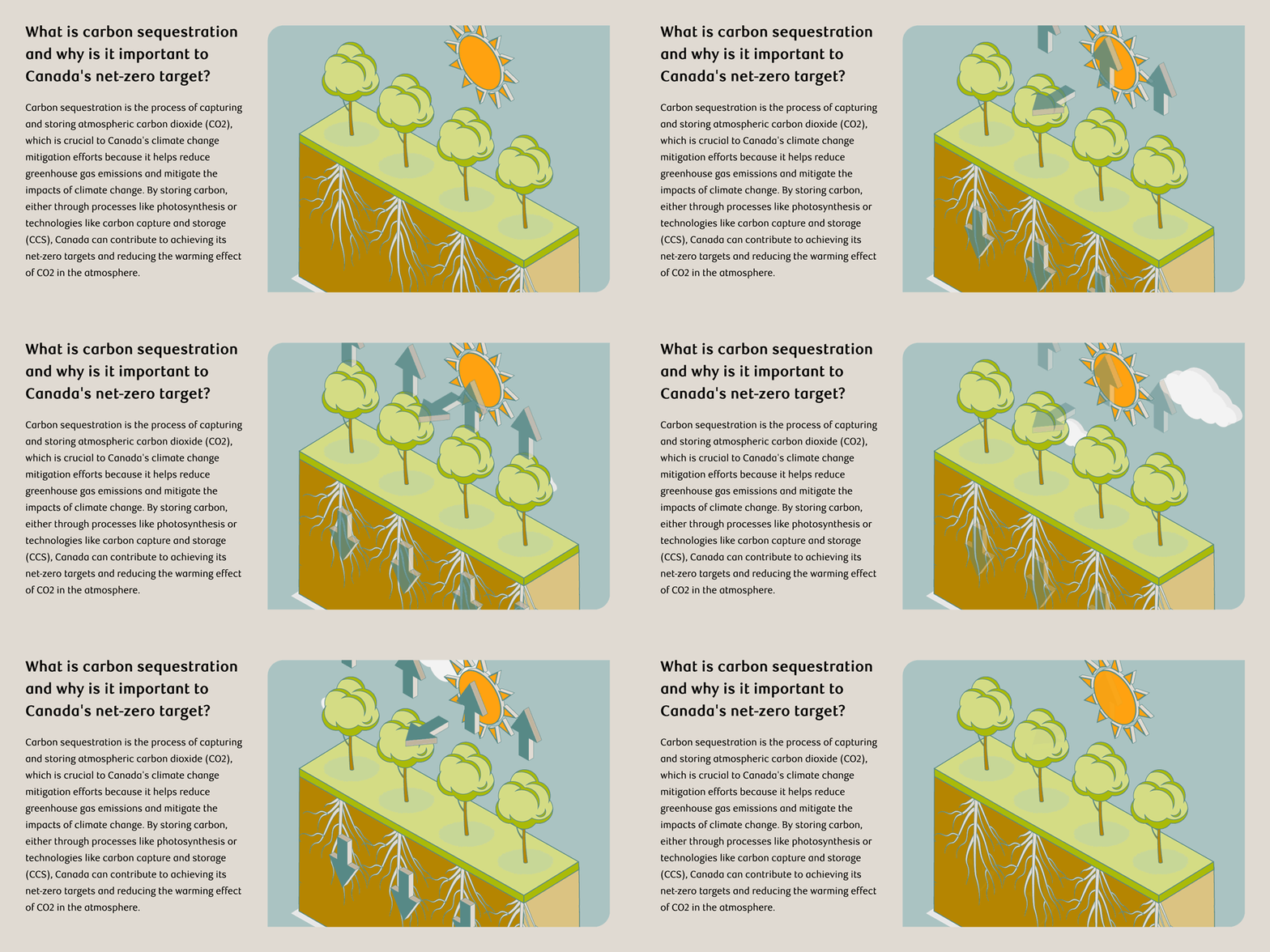 What is carbon sequestration and why is it important to Canada’s net-zero target? Carbon sequestration is the process of capturing and storing atmospheric carbon dioxide (CO2), which is crucial to Canada’s climate change mitigation efforts because it helps reduce greenhouse gas emissions and mitigate the impacts of climate change. By storing carbon, either through processes like photosynthesis or technologies like carbon capture and storage (CCS), Canada can contribute to achieving its net-zero targets and reducing the warming effect of CO2 in the atmosphere.
Carbon capture is the process of removing carbon dioxide (CO₂) from the atmosphere; carbon sequestration, meanwhile, is about storing that carbon, often in natural systems like trees, plants or soil. On farms and ranches, both can happen through regenerative practices such as cover cropping, mob grazing and protecting native grasslands.
While some carbon capture methods use industrial technology to trap emissions at their source, nature-based solutions offer a powerful, cost-effective way to both remove and store carbon through natural processes. And they come with meaningful benefits for farmers, such as healthier soil, improved biodiversity, higher yields, stronger water systems – and in many cases, new revenue streams through carbon credit programs.
In other words, supporting natural carbon capture and sequestration through sustainable agriculture isn’t just better for the planet—it can be better for the farm’s bottom line.
The challenge? Many farmers face barriers to accessing carbon markets. Programs often require large commitments – like enrolling entire farms – making it harder for small or medium operations to participate.
This is where ALUS comes in.
How ALUS is changing the game
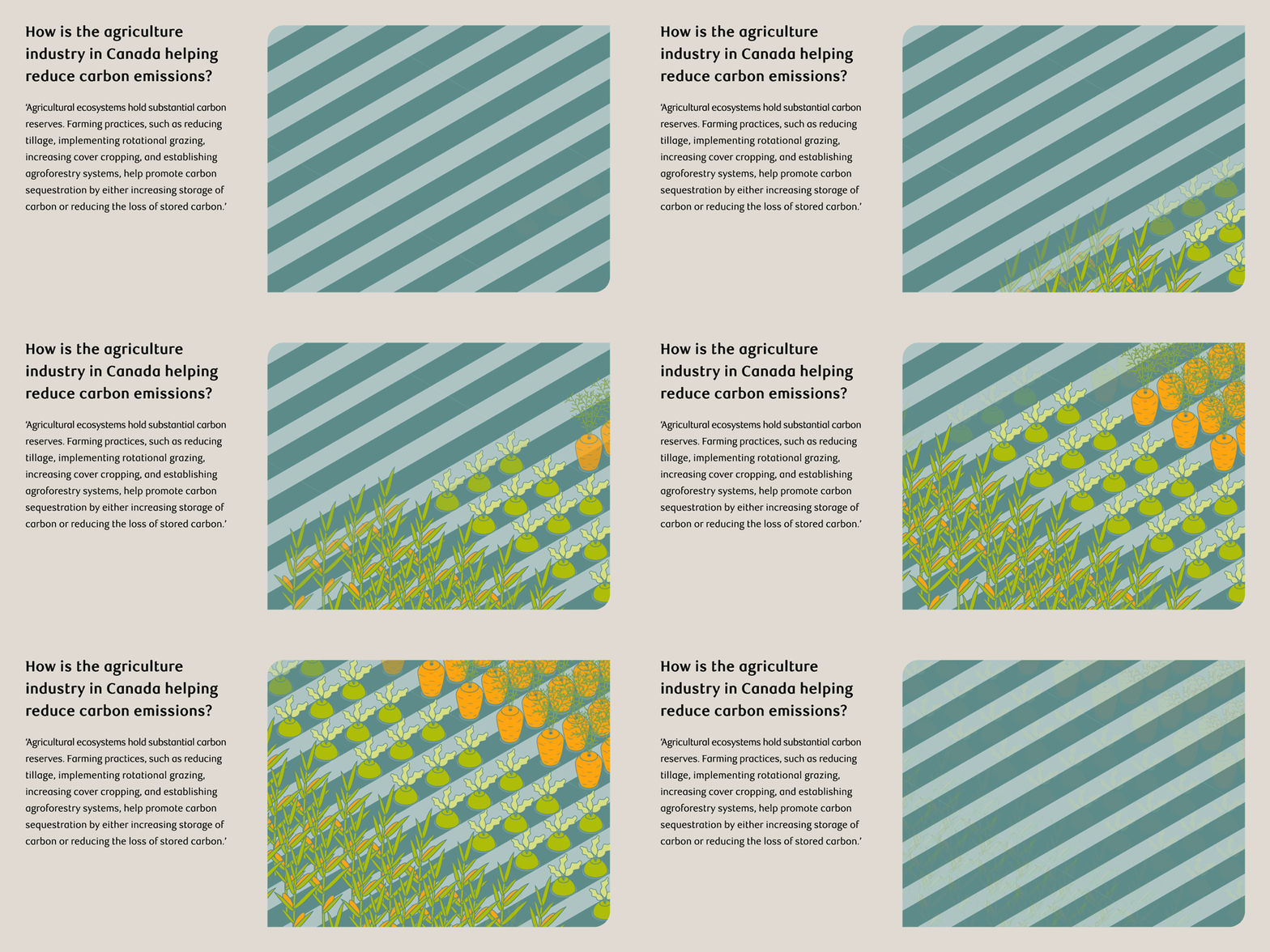 How is the agriculture industry in Canada helping reduce carbon emissions? ‘Agricultural ecosystems hold substantial carbon reserves. Farming practices, such as reducing tillage, implementing rotational grazing, increasing cover cropping, and establishing agroforestry systems, help promote carbon sequestration by either increasing storage of carbon or reducing the loss of stored carbon.’
ALUS is a national, farmer-led program that helps producers develop and deliver ecosystem services on their land. From the Richards Family Farm near Bangor, Saskatchewan, Paige Englot, Senior Hub Manager for the Prairies, discusses ALUS’ mission, goals and series of projects that are making a meaningful difference in supporting on-the-ground carbon storage efforts.
“ALUS engages farmers and ranchers creating nature-based solutions on their land,” explains Englot. “Solutions that enable carbon sequestration and reverse biodiversity loss for the benefit of their communities, for Canadians and for future generations.” ALUS works with farmers and ranchers to reimagine their farms, not just for the production of food and fibre, but to look at ecosystem services as a product on their ranch.
Through the ALUS Saskatchewan Assiniboine Project (ASAP) and other such initiatives, ALUS connects farmers with funding and technical support to help them launch environmental projects that are both effective for the land and their business. Unlike other programs, ALUS works on a per-acre basis, with flexible contracts designed around the realities of farming. With over 2,000 participants – and 41 active community hubs nationwide – ALUS is showing that small-scale, local action can drive big results.
A case study: The Richards Family Farm
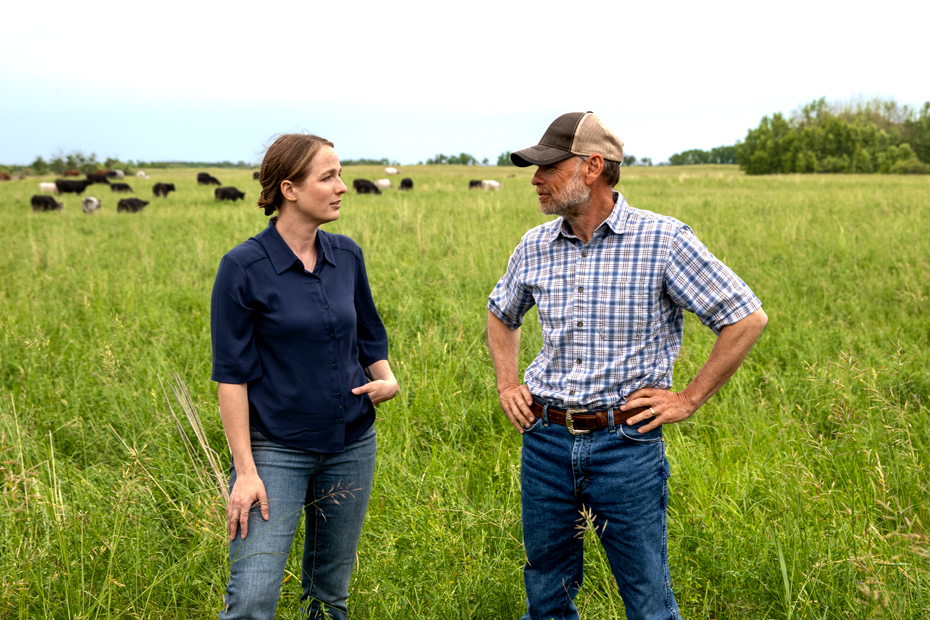
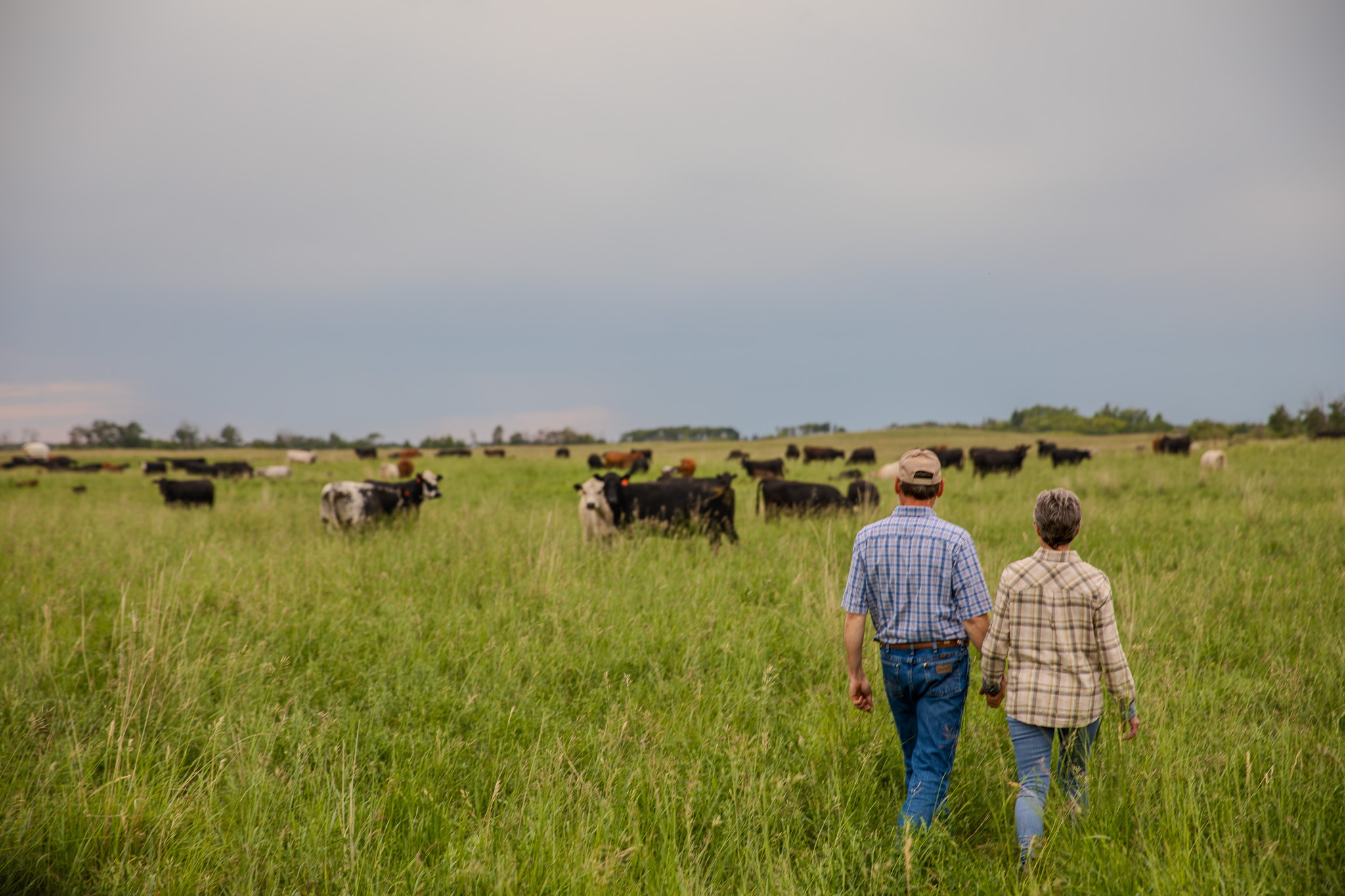 Garry and Lynn Richards on their ranch near Bangor, Sask.
The Richards family has been farming the same land since 1902. Today, Garry and Lynn Richards are leading the next chapter, investing in three key components of their farm: the business, the people and the land.
When it comes to the land, Garry puts it this way: “We’re investing in the land to make the soil healthier, the ecosystems healthier, to build the amount of life that we have here on the land, to increase the resilience of the water cycles, mineral cycles, carbon cycles… all those sorts of things. So, in the future, in ten years, we’ll have a more resilient and healthier farm.” A more resilient farm, he adds, is one that can better withstand climate challenges, whether that’s heat or cold, drought or flood.
With support from ALUS, the Richards family have converted portions of their grain land, introduced cover cropping and adopted mob grazing techniques that mimic natural animal patterns. These practices have helped increase biodiversity above and below the soil, improve water retention, and boost drought resilience. They’ve also increased soil carbon levels by 50%.
“We’ve seen huge changes in a short period of time,” Garry explains.
Beyond the initial funding to help convert their land, the ongoing guidance, practical advice and encouragement have had a significant impact on the Richards’ ability to thrive. “The support networks, mentorship relationships and encouragement we’ve received – the people part – has been a huge benefit to us,” says Garry.
Measuring impact: The ALUS Carbon Quantification Pilot
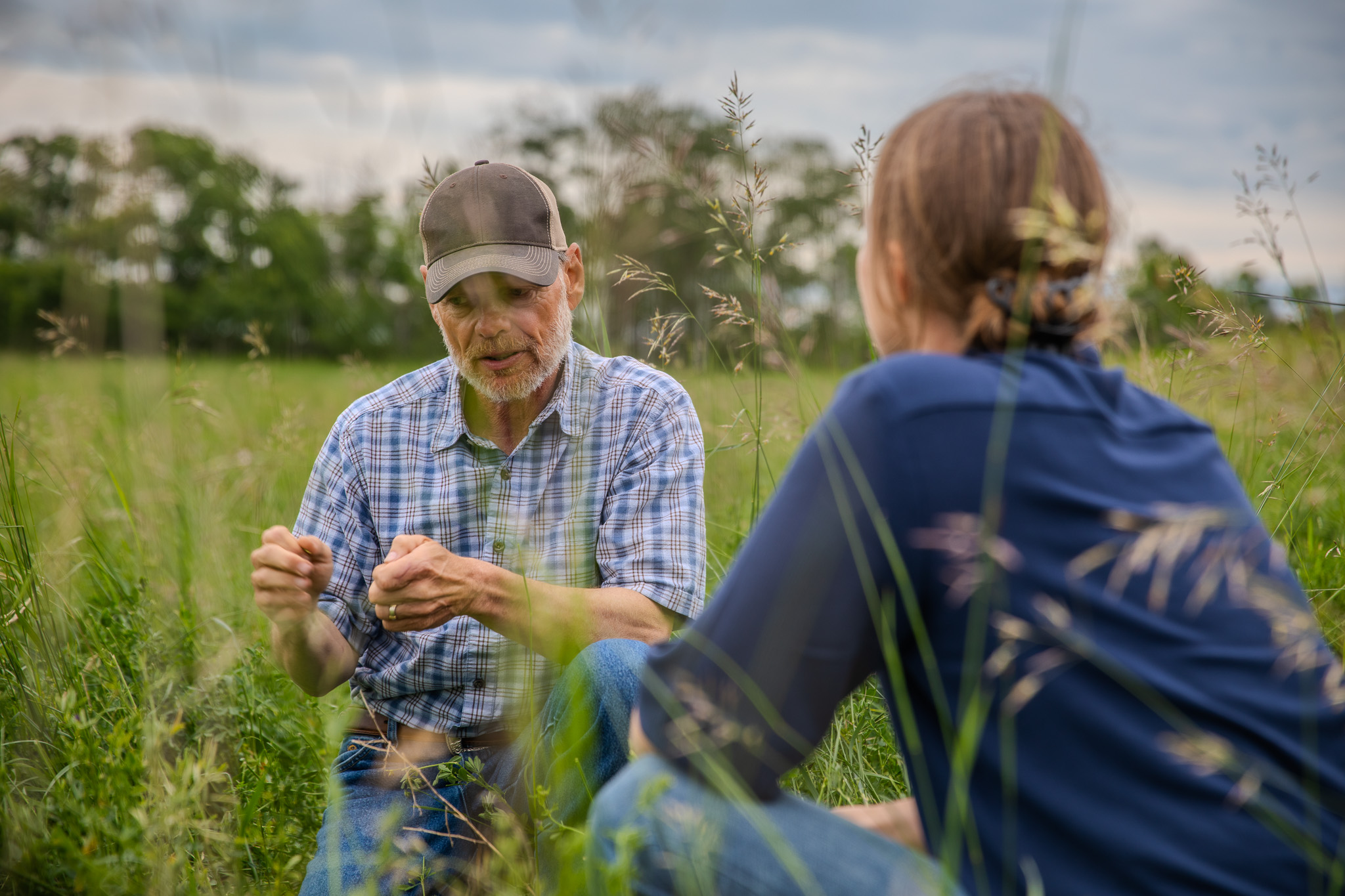 Garry Richards and Paige Englot on site at Garry’s ranch
To truly scale nature-based solutions, it’s critical to prove they work. That’s why ALUS launched the Carbon Quantification Pilot, with key funding and support from RBC and RBC Foundation.
This groundbreaking initiative is testing technology developed by climate technology firm EathOptics to measure carbon sequestration on farms and ranches across Canada. EarthOptics uses sensors and machine learning to measure year-over-year soil carbon changes with a high degree of accuracy.
ALUS combines these tools with traditional field sampling to measure soil carbon. This “ground-truthing” ensures the data reflects real-world conditions.
“Without the results of the field sampling, the modeling data can be unreliable in real-life situations,” explains Englot. “That’s why on-the-ground quantification is so important. Our partnership with RBC and RBC Foundation is central to implementing these innovative technology practices to validate our modeling system.”
A growing opportunity for climate impact
Agriculture has always been about working with the land – today, it has a critical role to play in supporting environmental resilience. With the right practices, farmers and ranchers can not only sustain their operations but also contribute to broader climate solutions by storing carbon, improving biodiversity and strengthening natural ecosystems.
That’s the vision behind ALUS. And thanks to the dedication of farmers and the support of partners like RBC and RBC Foundation, that vision is growing. What started with a handful of producers has grown into a national network of more than 2,000 participants, each delivering measurable impact through practical, nature-based solutions.
And as ALUS expands, so does its ability to quantify results, attract new investment and support even more farmers in building climate-smart operations that benefit their land, their livelihoods and their communities.
“Climate has always changed,” says Garry Richards. “Agriculture can be a big part of the solution. Because when the land is more resilient, so are we.”
This article offers general information only and is not intended as legal, financial or other professional advice. A professional advisor should be consulted regarding your specific situation. While information presented is believed to be factual and current, its accuracy is not guaranteed and it should not be regarded as a complete analysis of the subject matter discussed. All expressions of opinion reflect the judgment of the author(s) as of the date of publication and are subject to change. No endorsement of any third parties or their advice, opinions, information, products or services is expressly given or implied by Royal Bank of Canada or its affiliates.