简体中文
简体中文
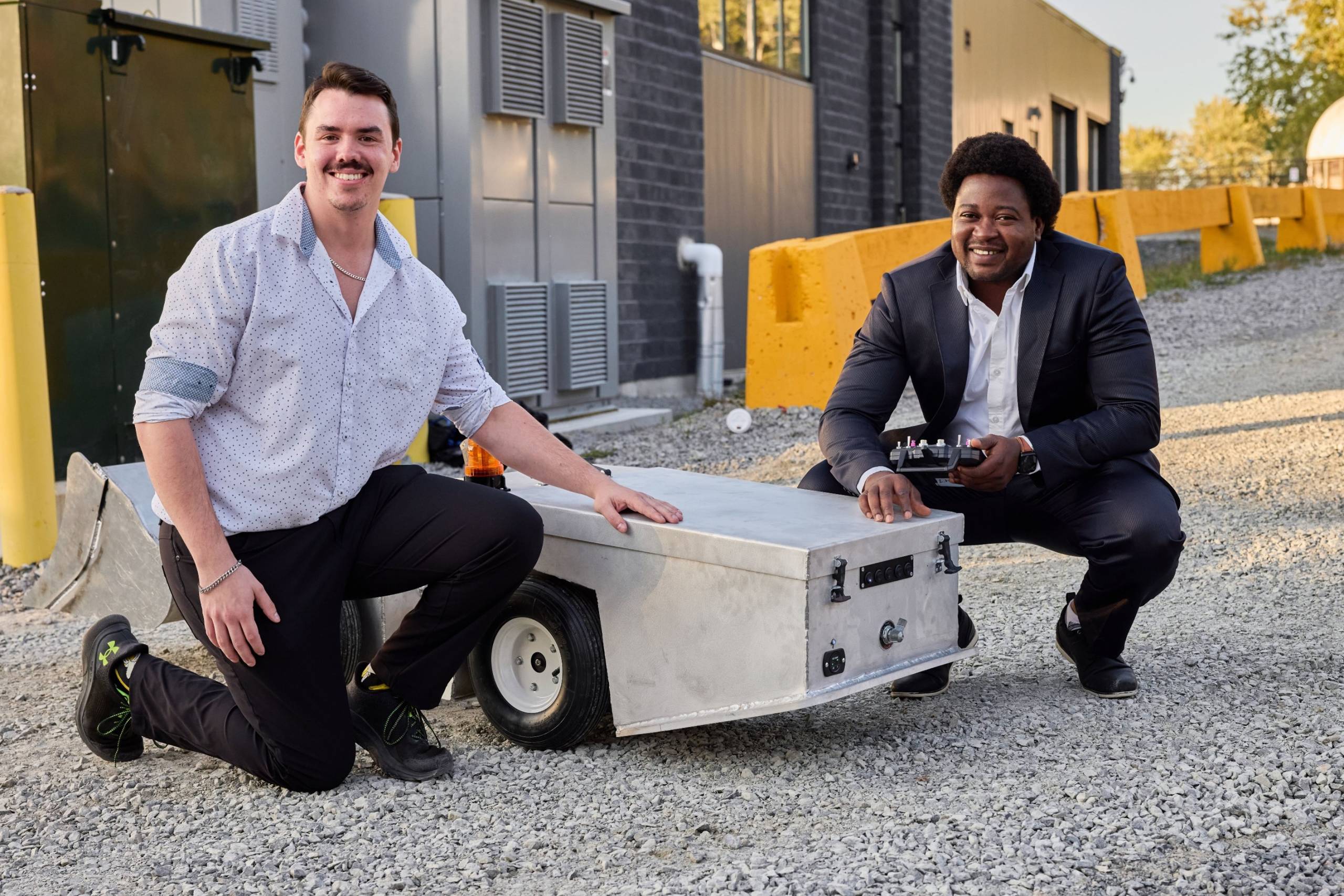
Photo: Cambrian College student Jacob Greenough (left) and research engineer Cheick Maiga showcase a mini Load Haul Dump. The Sudbury, Ont.-based school is facilitating the integration of battery-powered electric vehicles in the mining sector.
One of Jacob Greenough’s favourite things about stepping through the doors of Cambrian College’s new electric vehicle lab is the shared sense of purpose. The third-year mechatronics student was among the first to use this Sudbury, Ont. school’s facility, focused on electrification of large-scale vehicles and machinery used in mining.
“This is probably the best experience I’ve had in my life, being able to do so much hands-on work towards something really concrete, something that we know can make a difference for the environment. I’m graduating, but the new students coming into this program will have so much incredible equipment to work with.”
Mr. Greenough is one of hundreds of post-secondary students across Canada who are preparing for jobs supporting an environmentally sustainable future thanks in part to $16-million in commitments from RBC. Cambrian is using its $500,000 donation to give students the skills needed to support the net-zero transition in an important sector of Northern Ontario’s economy.
“Electrification in mining will be great for the environment, but there will also be lots of cost savings for the mines themselves,” says Mr. Greenough. “Think about a future where we won’t have to transport all of the fossil fuels out to the mines in order to run the machinery. It’s really exciting.”
The Vale Electric Vehicle Lab, part of Cambrian College’s applied research division, is focused on development, testing and deployment for a range of battery-powered electric vehicles.
Cambrian is one of three new RBC Foundation recipients announced this year. Since 2023, more than 25 post-secondary schools have received donations to help support the transition to a net-zero economy. That includes an environmentally sustainable farming leadership program at the University of Manitoba, heritage building conservation at Algonquin College in Perth, Ont., and solar panel maintenance labs at the Northern Alberta Institute of Technology.
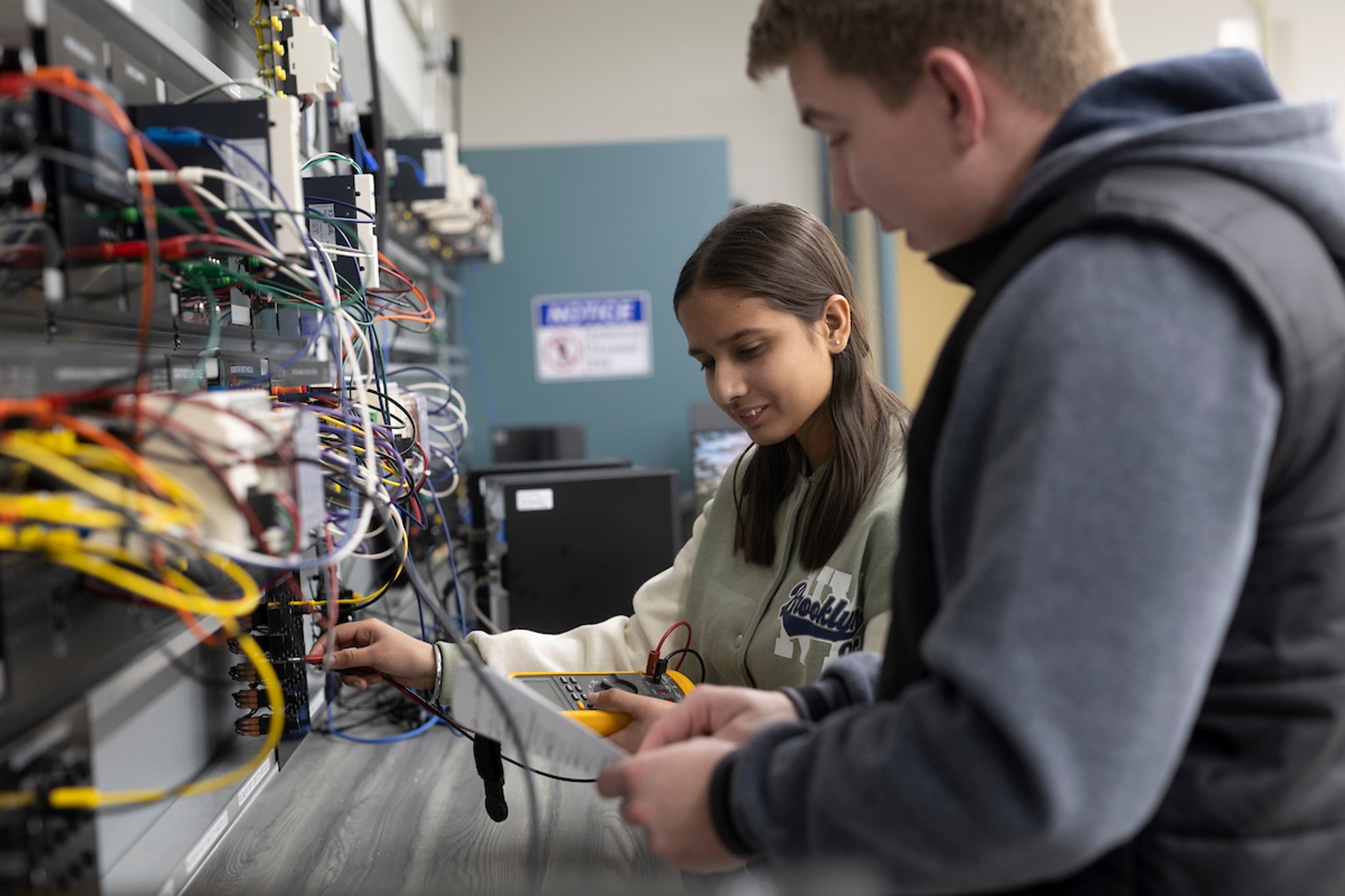 At Saskatchewan Polytechnic, mechanical engineering technology students work on an energy learning system. An $800,000 gift from the RBC Foundation to the school’s energy and resources lab will help support the transition to a net-zero economy.
Saskatchewan Polytechnic (Sask Polytech) and Red Deer Polytechnic are also new recipients. As with Cambrian, their green skills training is taking place in newly created labs dedicated to renewable energy. The Energy and Resources Lab at Sask Polytech’s Moose Jaw campus is focused on renewable technologies, smart grids and efficient construction.
An $800,000 donation from RBC Foundation will provide a ‘living lab’ experience, and help give students access to the most innovative technologies and tools in the renewable energy space.
“Our environmental sustainability-focused courses are popular, making RBC Foundation’s support timely,” said Dr. Larry Rosia, president and chief executive officer of Sask Polytech. “Being able to provide additional electives, new micro-credentials and more custom training focusing on energy – from solar to wind to geothermal – puts our students at the front of Canada’s skills revolution.”
In Red Deer, a $600,000 donation will help establish an energy test hub within the school’s Energy Innovation Centre. The new hub features a microgrid for testing and validating emerging technologies, including solar photovoltaic systems, electric vehicle charging stations, wind generation and battery storage systems.
In addition to making donations to colleges and universities, RBC is providing direct-to-student scholarships for the third consecutive year through Universities Canada.
In 2025, 40 RBC Green Skills Scholarship awards of $5,000 each are available to adult learners (25 or older) who are starting or returning to post-secondary studies to help develop innovative solutions to pressing environmental challenges. Areas of study must be related to buildings and construction, agriculture and food production, transportation, waste management and recycling or renewable energy.
For more information or to apply, visit RBC Green Skills Scholarships (applications are accepted until June 30, 2025).
“Over the next 10 years, 3.1 million Canadian jobs – or 15 per cent of the labour force – will be disrupted as the country transitions towards a net-zero economy,” says Andrea Barrack, RBC’s senior vice president of Sustainability and Impact. “By providing scholarships to Canadians interested in going back to school to be a part of this transition, and supporting innovative programs at these schools, our goal is to help students take advantage of the hundreds of thousands of new jobs to be added in fields where enhanced skills will be critical.”
This article offers general information only and is not intended as legal, financial or other professional advice. A professional advisor should be consulted regarding your specific situation. While information presented is believed to be factual and current, its accuracy is not guaranteed and it should not be regarded as a complete analysis of the subject matter discussed. All expressions of opinion reflect the judgment of the author(s) as of the date of publication and are subject to change. No endorsement of any third parties or their advice, opinions, information, products or services is expressly given or implied by Royal Bank of Canada or its affiliates.