简体中文
简体中文
This year’s A Chosen Journey: RBC Indigenous Partnership Report is a celebration of the promise, excellence and talent in Indigenous communities, the impact organizations, communities and community members are making and the power of teamwork. From the forests to the velodrome to the Arctic Circle and everywhere in between, our community partners are finding new ways of winning and protecting traditional ways of being. This story is an excerpt from this report.
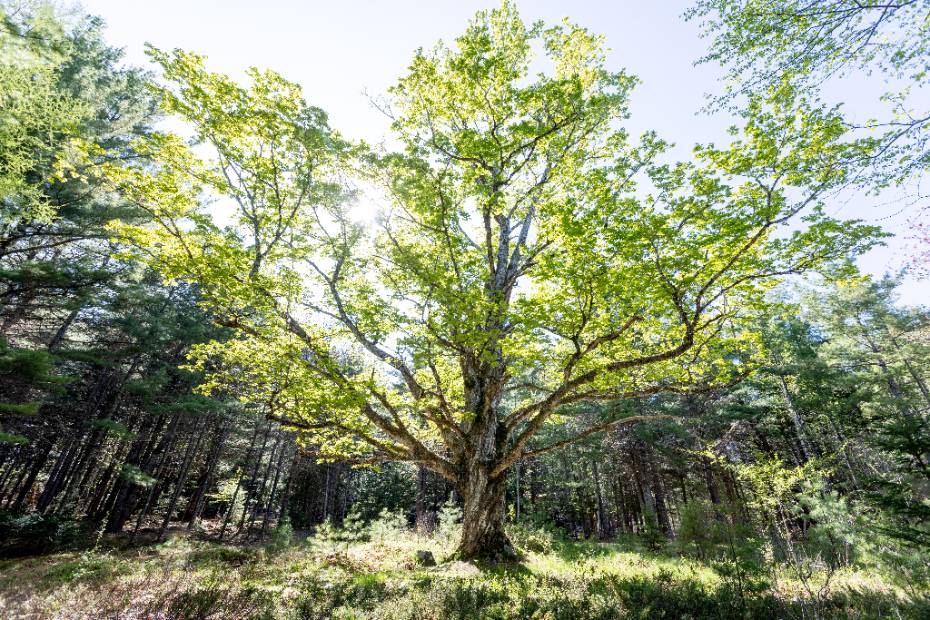
When an invasive species was found on a property neighbouring Asitu’lisk, 200 acres of ancient forest, waterways and spanning riparian zones on the south shore of Nova Scotia, something had to be done to protect the old growth hemlock trees. Community Forests International partnered with Ulnooweg Education Centre, who are caretakers of the land, to find a solution. The pest, called “hemlock woolly adelgid,” is a threat to the forest that has been there for over 400 years, with one tree, called Grandmother Maple, dating back more than 530 years.
The charitable organization Community Forests International, based in Sackville, New Brunswick, protects and restores forests at home and abroad. Ulnooweg Education Centre, an Indigenous-led charitable organization, develops and delivers programming to empower Indigenous communities. Guided by their traditional cultural values, they focus on science and innovation, agriculture, and financial literacy.
The two organizations took what’s called a “two-eyed seeing” approach to managing the crisis, combining “Western” science and the long-term multigenerational observational science of the Mi’kmaq people to find a solution. With community engagement, they co-developed a plan to manage the risk with funding from RBC Foundation.
“RBC is helping to support the transition to a low-carbon and resilient economy through nature-based solutions that address habitat loss, conserve biodiversity and build climate resilience. Supporting this project with Community Forests International and Asitu’lisk partners has provided an important opportunity to help preserve this ecologically and culturally significant forest of immense value to the Mi’kmaq,” says Thea Silver, Senior Director, Environmental Impact, RBC.
“There’s a lot of love there and you sense that when you go into the land. From our perspective, that’s how we want to treat it, right? We want to treat it like we treat an elder or a child, with a lot of tenderness,” explains Ulnooweg Chief Operating Officer Chris Googoo, reflecting on the care that was taken by the families that cared for the forest before management was transferred to their organization.
While taking a chemical approach to pest management was a difficult but unfortunately necessary choice, the results are speaking for themselves. 16.5 hectares of forest and 4,000 trees have been inoculated against this growing danger, preserving the lush lands for what’s hoped to be generations to come. Each tree and the chemicals to protect it were smudged with medicine, and workers left tobacco as an offering. They also utilized methodologies to quantify just how much carbon is in those trees and the potential impacts of the hemlock trees dying and releasing their stored carbon.
“The overarching hope is that it’s a strong, inspiring example of Indigenous-led forest care, and the decision-making process with consultations with Mi’kmaq elders, knowledge holders, community members, foresters and scientists. We believe wholeheartedly the original caretakers are the ones who know how to take care of the forest the best. They’ve proven it for many, many generations,” explains Dani Miller, Forest Diversity Manager at Community Forests International.
They’re protecting the trees that have been there for generations so that future generations can spend time among them. Community Forests International and Ulnooweg Education Centre are two organizations using “two-eye seeing” to work together so the forest and its inhabitants can see a brighter future.
This article offers general information only and is not intended as legal, financial or other professional advice. A professional advisor should be consulted regarding your specific situation. While information presented is believed to be factual and current, its accuracy is not guaranteed and it should not be regarded as a complete analysis of the subject matter discussed. All expressions of opinion reflect the judgment of the author(s) as of the date of publication and are subject to change. No endorsement of any third parties or their advice, opinions, information, products or services is expressly given or implied by Royal Bank of Canada or its affiliates.