简体中文
简体中文
The Nisg̱a’a Nation has long exemplified resilience in its pursuit of self-governance. A major milestone came in May 2000 with the enactment of the Nisg̱a’a Final Agreement – the first modern-day treaty in Canada. This landmark agreement affirmed Indigenous rights and empowered the Nisg̱a’a to create governance structures, laws and policies rooted in their traditional protocols – a testament to their enduring strength and self-determination.
Beyond its impressive political achievements, Nisg̱a’a Nation has maintained its commitment to preserving culture, language and tradition. “We are Nisg̱a’a. I know who I am, and I come from the lands of my family, the Killerwhale clan, where we lived on for thousands of years,” shares Andrew Robinson, Chief Executive Officer of Nisg̱a’a Lisims Government. Andrew is from Gisk’aast (Killerwhale) tribe from the Wilp of Ni’isyuus, and lives in his home community of Lax̱g̱alts’ap. He embodies his people’s cultural pride in their traditional territories.
This connection to land is foundational to Nisg̱a’a identity, but it also comes with challenges. Gitlaxt’aamiks (New Aiyansh), the administrative capital and largest of the four Nisg̱a’a villages, is nestled in the Nass River Valley, about 100 km north of Terrace, British Columbia. Its remote location often makes access to essential services difficult, including banking. Many citizens face barriers to financial services, including transportation costs, experiences of racism or the emotional toll of navigating systems shaped by colonial legacies.
Recognizing these challenges required a financial partner willing to understand the community’s unique context. Over the years, Nisg̱a’a developed a relationship with RBC rooted in mutual respect and transparency.
“We needed to show up humbly,” says Tara Brown, Vice President of Group Advantage at RBC, and a Gitxsan member. “It was about arriving with intention and a genuine understanding of the community’s needs, not with our own agenda. The relationship has grown from a bank-nation relationship into a friendship.”
This foundation of trust opened the door for meaningful conversations and encouraged Nisg̱a’a executive leadership to invite RBC to approach banking differently, centering community needs over institutional goals. Together, they created a plan to support citizens with foundational banking services, from opening accounts to learning about investing.
“RBC stood beside us – not to pursue their goals, but to help our citizens achieve theirs,” Andrew explains. “That’s what reconciliation should look like. You have to hear our story to understand us.”
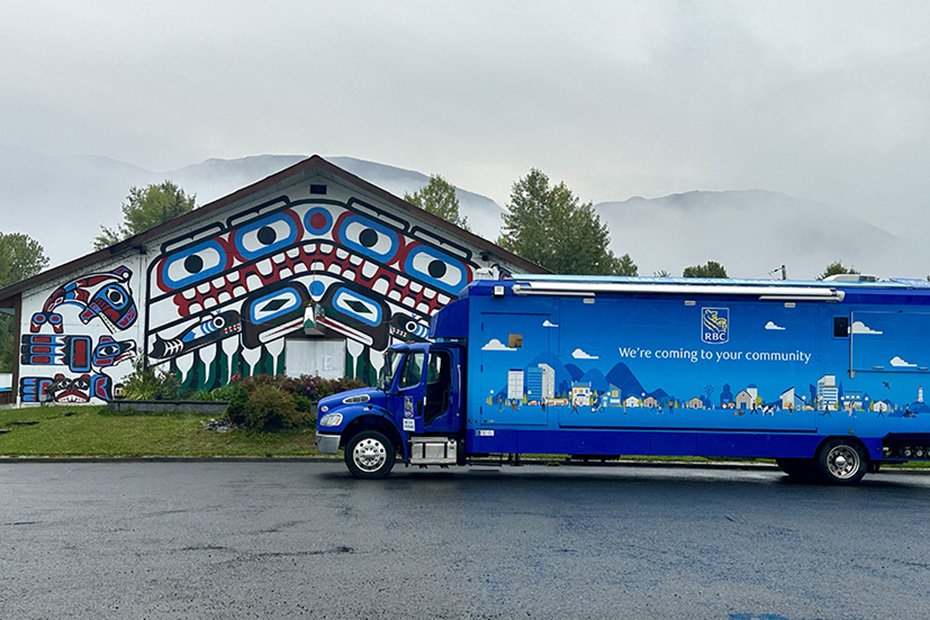
In September 2024, the RBC Truck, a functional branch on wheels, arrived in Gitlaxt’aamiks Village for four days to bring banking into the community. It offered a fully operational ATM, one-on-one appointments, and small-group seminars on fraud protection, credit access, mobile banking, saving, investing and resources around RBC’s On Reserve Loan Housing Program. The seminars were shaped by the needs identified by community citizens and leadership—another sign that RBC was listening closely.
“With the RBC truck, we created a safe and open environment where we came to them instead of expecting them to come to us,” Tara expresses.
The initiative was transformative for citizens, as it increased financial knowledge and opened the door to vulnerable conversations about finance. Elders learned how to plan more effectively for retirement. Young men in the community reported newfound confidence and financial independence after learning about direct deposit. Citizens opened savings accounts and explored mortgage options.
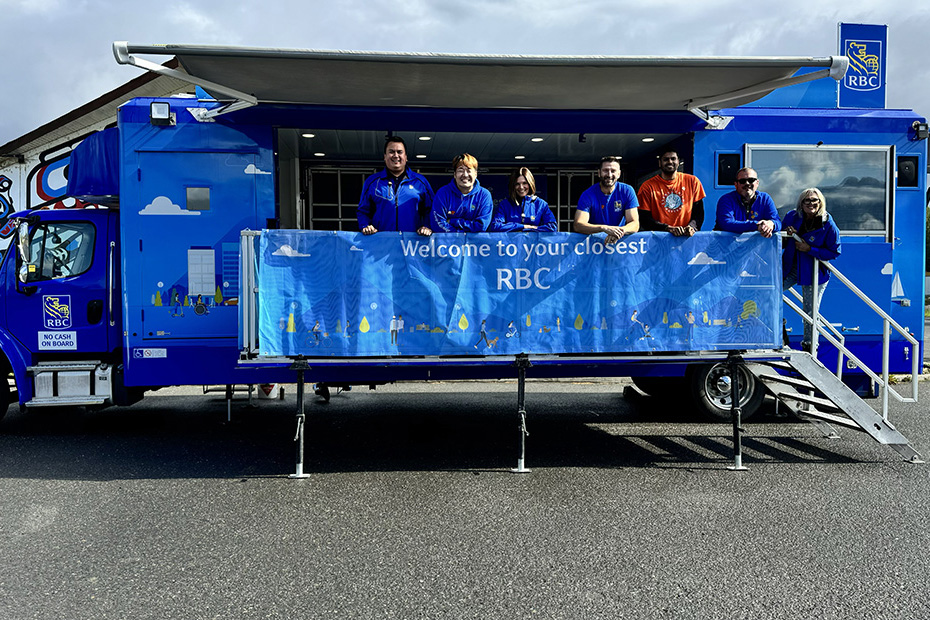
RBC team members welcome citizens at the mobile branch, ready to build meaningful connections and support the community’s financial goals.
The experience proved equally valuable for RBC staff, who witnessed firsthand the impact of removing financial barriers. Listening to citizens’ stories and building personal connections gave team members more profound insights into Nisg̱a’a culture and worldviews.
The RBC Truck represented a small but meaningful step in changing perceptions of banking and demonstrated that reconciliation requires actions, not words.
“When the RBC truck arrived, it broke down years of barriers – physical, emotional, and institutional,” Andrew reflects. “It showed people that banking could be accessible and supportive. A 17-year-old citizen called me to calculate his trust interest rate based on his engagement with the mobile services. That conversation never would’ve happened without this initiative.”
This is just the beginning to ensure wealth stays within the Nisg̱a’a economy and that all citizens can access financial services. The positive response has sparked requests for more, including a permanent ATM in the community. Starting with bringing back the Truck, RBC is exploring ways to return and deepen its commitment to long-term financial accessibility in the region.
Looking toward the future, Andrew reflects on Nisg̱a’a Nation’s journey. “We’ve fought for 113 years for a modern treaty, and 25 years into self-government. We’re now asking: What does financial literacy and wealth development look like, for our people today and future generations?”
This question represents the next chapter in the Nisg̱a’a Nation’s journey of self-determination – one that moves from securing rights to building lasting prosperity. As that journey unfolds, RBC is proud to stand as a trusted partner –walking alongside the Nisg̱a’a Nation with a shared commitment to breaking down systemic barriers and advancing meaningful economic reconciliation.
This article offers general information only and is not intended as legal, financial or other professional advice. A professional advisor should be consulted regarding your specific situation. While information presented is believed to be factual and current, its accuracy is not guaranteed and it should not be regarded as a complete analysis of the subject matter discussed. All expressions of opinion reflect the judgment of the author(s) as of the date of publication and are subject to change. No endorsement of any third parties or their advice, opinions, information, products or services is expressly given or implied by Royal Bank of Canada or its affiliates.